Monday, September 28, 2009

Little Town, It's a Quiet Village...


Je vais voyager à Tours, mes amis! J'ai peur, mais je sais que tout sera bien. Je suis le plus excited pour la culture. Ne mettez pas vos mains sous la table, non! Ne souriez pas a personne, ou les hommes recevront une mauvaise idée. J'ai vu quelque photographies de Tours. Je pense que c'est une petite ville, mais ils ont des choses à faire. Sam, Courtney, et Mary-Elizabeth veulent voyager à Tours aussi. Il serait bon d'avoir des amis avec moi. Ce sera mon premiere voyage à travers l'océan. Ah, juin. Je ne peux pas vous attendre.

I'm going to Tours, my friends! I'm scared, but I know that everything will be okay. I'm the most excited for the culture. Don't put your hands under the table! Don't smile at anyone, or the men will get the wrong impression. I saw some photos of Tours; it looks like a small city, but they have things to do there. Sam, Courtney, and Mary-Elizabeth want to go to Tours as well. It would be nice to have some friends with me. This will be my first trip overseas. I can't wait for June.

Wednesday, September 23, 2009

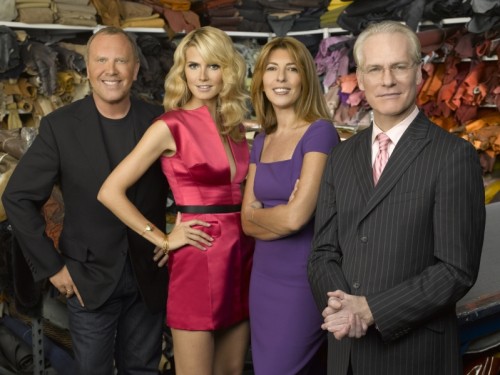
Where are Michael and Nina?


Maybe we're unaware of a Project Runway challenge that involved making Michael Kors and Nina Garcia an invisibility cloak. Or maybe the invisibility cloak is just the latest fashion trend. All I know is that Nina and Michael have been missing from various episodes this season. The preview for tomorrow's show didn't feature them either.

Everyone needs a sick day. Perhaps these two have H1N1. I just want an explanation as to why they're being replaced on the judging panel by people like: Lindsay Lohan, Rachel Bilson, and Eva Longoria-Parker. Most celebrities are styled by a stylist. Why not have Rachel Zoe sit in for Kors or Garcia? I highly doubt these celebrity replacements have as much industry experience as a stylist. Or why not have Tim Gunn as a guest judge? He follows the designers through their entire creative process! Don't you think he might know a bit about who deserves to stay and who needs to go home?

There's a reason the winner of Project Runway is separate from the winner of "America's Favorite." The judge's panel is there to aid America in seeing what is innovative design and what is not. I understand giving the host of the show (Heidi Klum) input in the decisions, much like Padma Lakshmi has input in the decisions made in Top Chef. But in my opinion, including these wannabe fashionistas in the judging panel is unfair. It's like having me sit up there in place of Michael Kors. I would have no idea what I was talking about. "I like it. It's different. I would wear that," are the only comments these celebrities can come up with. I think the designers would much rather have the opinions of Nina Garcia and Michael Kors than Lindsay Lohan.

Please, Nina Garcia and Michael Kors, I'm begging you to ditch the disappearing act. America is lost without you!

Monday, September 21, 2009

Sean Penn: From Rebellious Bad Boy to Wholesome Milk

We've all heard of the movie Milk, and we've all heard of the film's lead actor, the always rebellious Sean Penn. But how much do we really know about this leading man? Milk won two Oscars at last year's Academy Awards, including Best Performance by an Actor in a Leading Role. How does Sean Penn go from Mick O'Brien in Bad Boys (1983) to the gentle persona of Harvey Milk in last year's Milk? Rolling Stone's Mark Binelli spent a total of five hours with Penn at his home in Marlin County, California to learn more about the actor.

Named the "greatest actor of his generation," Penn has a whopping thirty years of work under his belt. An Oscar nomination for Best Actor would not be considered extraordinary, but his latest nomination for Milk is a surprise, all due to Penn's unexpected career choice. In Milk, Penn plays a kind gay politician who was murdered in 1978. This is an unusual departure from Penn's usual dark, serious roles. As always, Penn was unafraid to give his all in his performance. When asked by Binelli if it was appealing to play a person so different from his own public persona, Penn responded: "He appealed, period. I liked him so much, I just thought, 'Can I find him in myself?' I didn't know. And there were times when I'd given it a go and really felt like I failed. You don't know. You just hope."

His hope ended up paying off in Oscar form. Perhaps his performance was inspired by his respect for the real Harvey Milk. Penn stated in the Rolling Stone interview that he believes Milk would be a powerful voice if he were alive today. Binelli asked, "Playing a real-life person like Milk, with so much archival footage to look at, is there a danger of just doing an impression?" Penn answered, "Yeah, but I don't know how to do impressions. I can't sing, either. So there's that. The main problem was that normally, to tell a whole life in two hours, you want to get somebody more charismatic than the real person. And in this case, one could only aspire to that."

This isn't the first time Penn has expressed his feelings about being committed to a role. He stated in the interview that he feels many actors spend more time endorsing than acting: "People are spending too much time modeling for some fucking clothing company instead of acting, and I resent it." On the shoot for Clint Eastwood's Mystic River, it was written in to the script that Penn be held back by six men while trying to fight to see his daughter's dead body. Penn spoke with Eastwood and convinced him to up the count to fifteen men. That way, Penn could go crazy with head-butting and biting, and no one would get hurt.

Maybe with this Oscar, Penn will be received as the multi-faceted actor he is. Even though Penn says he's open to comedies, he's never really been offered them. The right roles just fall into his lap. He said, "I'm more interested in the way drama tends to resonate in people's lives, versus that kind of escapism." While Penn has expressed a sort of apathy for his acting career, he thinks of himself as more of an auteur. When asked by Binelli if his ambivalence was part of his not feeling like he has many peers, Penn responded, "No, and don't misunderstand me--It's not that I don't have peers. I just feel sad about where the culture of my profession is. The people who I feel are still part of an old school are the people that I relate to. But generally, the job of directing is the job I'd rather be doing." Whether acting or directing in the future, it's clear we can always expect a wholly committed Penn.

Wednesday, September 16, 2009

A Revelation in a Dark Room

I'm used to watching the scenes in front of me through a digital screen on the back of my camera. I watch the screen, half-press the big silver button, and then take a picture. I could take twenty pictures of the ocean before I found one I liked. I've known how to work a digital camera for years.
That being said, I never imagined the patience and meticulousness that go into traditional photography.
First, there's the manual camera.
"What is this thing?! It weighs ten pounds!"
I can't tell you how many buttons and control panels are on my Nikon N90S, but I can tell you it's well over the three on my Kodak digital.
Each shot takes about a minute to prepare. Press your eye to the viewfinder, focus the image, adjust the aperture and shutter speed, and take the picture before the shot changes. It doesn't sound like much work, but it's certainly more work than aiming and clicking at whatever strikes your fancy.
Then there's the darkroom. No, you can't plug the USB cord into your computer and upload the photos in an instant. You have to stumble blindly into a room that's pitch black, take the cap of your film off with a bottle-opener, and wrap your film seamlessly around a film reel.
Please take note: I can't make it from my bed to my door in the dark. In other words, the darkroom was a challenge.
While swishing chemicals around in the film canister that held my film, I wondered about the end result. Why all this effort? Isn't this why digital cameras now exist? To make our lives easier?
The film dried after another fifteen minutes and as I pulled the negatives off the reel I realized how much of a mess I'd made of rolling the film. It was completely mangled. There were pink stains covering nearly half my negatives, but for some reason I wasn't too disheartened. I'd never held my own negatives up to the light before. These were the photographs I planned. Tiny, black and white versions, but mine nonetheless. They were how I spent my Sunday afternoon, they were all my struggles learning how to operate a manual camera, and they were my first mistakes in the darkroom.
Digital cameras offer us easy access. Manual cameras offer us a sense of accomplishment and pride. The whole film-developing process fosters a connection between you and your photographs. That connection is the difference between feeling like a teenager with a camera and feeling like an artist.

Wednesday, September 9, 2009

Reform greets America's character


President Obama addressed a joint congress this evening regarding his plans for America's health care. Obama offered options for the 30 million Americans who cannot get coverage. He acknowledged the ideas of both the left and right, but said neither were perfect. He then asked America to support him in building on the health care system already in place, rather than disrupting it.

Obama reiterated the idea of "action now," stating that "our health care problem is our deficit problem." He spoke optimistically about the future of American health care, and the fact that this future lies with America's character. "We did not come here to fear the future. We came here to shape it," received applause from both parties at the end of the night.


President Obama refuses to sign a plan
that will add to America's deficit.

Sunday, September 6, 2009

The Recounting of a Scene

I've decided to splurge on dinner. That's right, I'm dining at Panera. Why not? Tomorrow's a holiday (meaning we don't have class), so I've all the time in the world to relax tonight. Each Panera I visit seems to be arranged differently than the last. The placement of the cafe line in relation to the bakery line, the booths, everything is just a bit off. The booths on the far end of the restaurant are all filled up, but most of the tables are empty. The cashiers look at me while I take my time scrutinizing the menu. After I order I snatch up a booth and see that mostly young people are here. There's only one table of senior citizens.
Classical music is playing softly overhead, but it's interrupted by the buzzer that signals my order is ready.
There are five girls, about nineteen-years-old, gathered at the back table, all clad in athletic shorts and t-shirts. Two booths down from me there's a girl with her back to me.There are chopsticks in her hair and she's sitting across from a friend with striking black and red hair. The smoothie drinker in the corner booth is studying with a pen clenched between her teeth. Another smoothie drinker is sitting by the fireplace, smiling at his laptop. The salad eaters across from me are discussing
Dante's Inferno and the senior citizens are all munching on a "You Pick Two" half sandwich, half soup combo.
I, the tomato soup drinker, am relaxing from a long week and enjoying their company.
Everyone except the studier and laptop user are engaging in conversation. The old man wearing blue suspenders is sitting with two older women. One of these women cracks up laughing every few minutes. People walk by outside, unaware of the people (or person) staring at them from inside Panera.
The laptop user nods at me, for some reason, on his way out of the restaurant. A man I hadn't noticed leaves wearing a biker helmet and jacket. I watch him ride away a few moments later. After finishing their food, a young couple moves from their booth over to the front of the fireplace, just talking. A man with long, curly grey hair enters with his two young daughters.
The old woman sips on an iced tea that's not half empty by the time she leaves with the other woman and man.
When there are no customers up front, laughter rings out from behind the cashier counter.
The young girlfriend is trying to wrestle something from her boyfriend's hands.
"This is painful," he says.
"If you were a good boyfriend you'd give it to me!"
I have no idea what they're quarreling over, but the boy obviously noticed me watching them. He stuck a quarter in his eye, to which his girlfriend responded, "Stop being a ham."
One of the salad eaters gets a phone call, answers it, and convinces the other salad eater it's time to go home. Now only the man with his daughters and the young couple remain.
It's 7:06 and one of the cashiers starts sweeping around the self-serve coffee counter.
I leave the remaining customers and workers at 7:07--wondering if I'll miss anything exciting after I go.

Wednesday, September 2, 2009

Movies that Stick with You

Recently I was posed the question: "What's the first movie that opened up your mind to what a film could do?" The first film that popped into my mind was, of course a favorite of mine, Eternal Sunshine of the Spotless Mind. I'm normally not one to deconstruct films. I'd rather just enjoy the thing as a whole. If I'm watching something like, say The Prestige, I'll notice overt loopholes, but I'm not painstakingly looking for plot flaws. It was hard for me to think of a film in such specific terms.

Eternal Sunshine
is mind-boggling, yes. But surely, I thought, there must have been a movie that moved me before that.


After thinking about it for a while I decided upon
Edward Scissorhands. Why?


A. Theme of Two Worlds Merging Together


B. The Sympathy Felt for Edward


The family in this movie lives in suburbia "heaven," if you can call it that. The houses are painted robin's egg blue, canary yellow, you know--all those bird colors. The lawns are mowed daily, the floors vacuumed daily, and the children fed daily. (Let's hope the last happens in most suburban homes.)

Edward lives in a dark, seemingly abandoned mansion on the outskirts of town.
The film merges these two polar opposites quite nicely, or for as long as it could allow.


Google a picture of Edward Scissorhands. Aside from the puppy-dog look on his face, he's a generally frightening guy, yes? Yet I fell in love with him. His sense of right and wrong are skewed, but his heart is in the right place. Find a wallet? Use the money to buy gifts for your friends and family. A touching idea. Edward longs so desperately to belong to this suburban community. He loves giving all the women haircuts, helping all the men trim their hedges. Who couldn't love this charming man? And the fact that his backstory is so tragic just makes him even more lovable.


I guess seeing this at such a young age made an impact on me because it made me realize everyone is less alone than they feel. So often people feel alienated and alone when they're truly not.


It's one thing to read about a character like Edward in a book. To see him, to observe him in our own world through film, is more stirring.


Are there certain movies for anyone out there that changed your perception of what film could do?